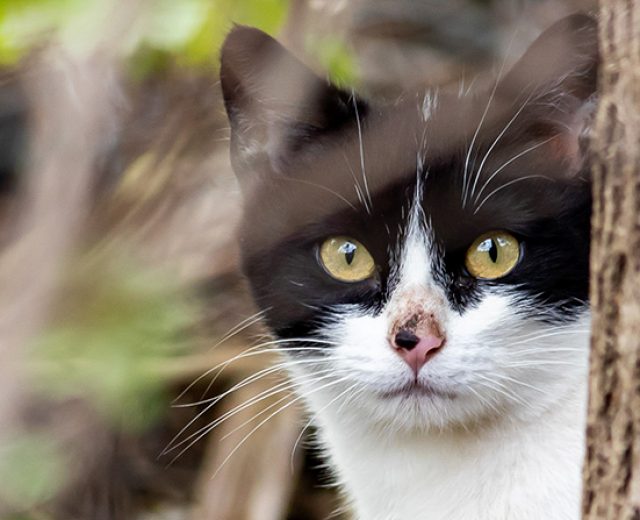
Creating Opportunities Beyond Traditional Adoption
Tree House’s Cats at Work program provides a safe, humane solution for undersocialized cats who cannot return to their original territory and are not suited for traditional indoor adoption. These cats are placed in small outdoor colonies of two or three cats in residential or commercial settings, where they receive food, water, shelter, and ongoing care from dedicated caretakers. In return, the cats help naturally manage rodent populations while living healthy, enriched lives in environments where they can thrive.
Hire a Cat At Work
General Guidelines for Working Cats
- There should be an area where the acclimation crates can be placed—a private, shaded area is preferred! We’ll work with you to determine the area most suitable for you and the cats!
- You should own the property where the cats will be placed, or have your landlord’s permission to do so.
- Neighbor support! Let’s foster good neighbor relationships and give our neighbors a heads-up.
Applications are open for the Summer 2026 CAW program!
Submit Your Application
Complete the application to tell us more about your location and interest in the program.
Site Review
Our team will review your address and assess the location on Google Maps to determine whether it meets the program’s needs and is a good fit for working cats.
Connect with Our Team
We’ll follow up by email to let you know whether your site is eligible to move forward. If it is, we’ll invite you to schedule a phone call to discuss the program in more detail and answer any questions you may have.


Food Code Laws
Due to food safety laws, we aren’t able to accept applications from restaurants at this time.
Page 208 6-501.115 Prohibiting Animals.
(A) Except as specified in Paragraphs (B) and (C) of this section, live animals may not be allowed on the PREMISES of a RETAIL FOOD ESTABLISHMENT. Pf (B) Live animals may be allowed as follows, if the contamination of FOOD, clean EQUIPMENT, UTENSILS, and LINENS, and unwrapped SINGLE-SERVICE and SINGLE-USE ARTICLES cannot result
Rules & Regulations
4-8-031 Retail food establishment (b) No retail food establishment shall permit any animal, other than a service animal assisting a person with a disability, on any portion of the retail food establishment’s premises, unless all of the requirements in subsection (d) of this section are complied with.
Municipal Code of Chicago
FAQs
I want to adopt “working cats.” What would my everyday life look like?
Relocation is divided into two major parts: acclimation for three weeks and release. The acclimation period is crucial for the cats. It’s when they become familiar with the scents and sounds in their new environment. You help build trust and connection by making bonding time and consistent feeding part of each day.
- Morning: Practice Pavlov’s Classical Conditioning Law by ringing the feeding bell and feeding the cats in the acclimation crate. We want the cats to associate the bell with food. While feeding the cats, attempt to bond with them by talking to them or sitting near them for a couple of minutes.
- 1-2 hours later, remove the uneaten food. The remaining food can attract other critters, and we want the cats to get used to finishing their meals within a certain period!
- Early evening: Ring the bell and feed the cats in the acclimation crate. And, you guessed it, attempt to bond with them! Sticking to a feeding schedule helps with seeing the cats at the same time each day.
- 1-2 hours later, remove the uneaten food.
When the cats are released after being in the acclimation crate for three weeks, practice the same feeding schedule! Consistency is key.
Is there a cost?
The base cost for the program ranges between $350-$420. This covers the supplies the cats will need during acclimation and beyond. Any concerns regarding cost? Let us know!
Shouldn’t we be taking cats off the street?
Our Cats at Work cats are undersocialized cats, not house cats, that need to be relocated for various reasons. Because they would not thrive in a shelter or home environment, these cats have frequently been overlooked in the past, often resulting in long stays at animal control or even euthanasia. We trap, neuter, and vaccinate undersocialized cats before returning them to an outdoor colony with a registered caretaker. These caretakers make sure their cats are well cared for by providing food, water, and shelter!
Chicago is cold! How do they survive the winter?
Chicago winters are pretty brutal, but it’s nothing community cats can’t handle! Tree House provides insulated shelters, heated pads, and a heated water bowl to help keep the cats warm. You may see the cats less because they hibernate just like other outdoor critters. Cats are incredibly resilient!
Those cats look pretty friendly…
Any cat that Tree House rescues undergoes an acclimation and behavior assessment by our clinic staff. We do our best to ensure we aren’t placing cats outside who might thrive better indoors. Sometimes, an outdoor or free roaming cat will grow comfortable with their caretakers and neighbors they see often. Cat behavior is as nuanced as human behavior! To learn more about the socialization spectrum, read this helpful piece from our friends at Alley Cat Allies.
What about the bird population?
By practicing TNVR (trap/neuter/vaccinate/return), we are able to control cat populations and reduce the number of undersocialized cats and create a net positive impact on the small animal population of Chicago. While outdoor cats (managed and not) are natural predators to birds, Tree House Cats at Work are also provided with food, water, and shelter. Best Friends has an excellent resource on how TNR helps with wildlife conservation!
Don’t rats carry disease?
Our Cats at Work cats are free-roaming cats who have already gone through the trap/neuter/return process and are vaccinated against diseases like rabies. While undersocialized cats do kill rats, often their pheromones are enough to scare rats away.
